Austin-Zierke Clinical Risk Partners

Clinical Risk Monitor

Recurring risk intelligence for pregnancy help organizations and healthcare nonprofits

Recurring assessment of your privacy, security, and compliance posture — every formal report reviewed and signed by a named compliance expert. Built for pregnancy help organizations and small healthcare nonprofits that need hospital-grade expectations on nonprofit resources.

Ready to talk — consultation. Want the board packet first — briefing.

Currently onboarding a limited number of organizations. Consultations are scheduled in the order requests are received.

What Clinical Risk Monitor is

What is Clinical Risk Monitor? Clinical Risk Monitor is a partner engagement, not a software license, from Austin-Zierke Clinical Risk Partners. On a defined schedule, industry-standard tools produce technical evidence; an AI analysis layer maps and drafts; a named compliance expert reviews the evidence and signs every formal report. The AI drafts; it never signs. It is not managed IT replacement, not continuous cybersecurity protection, and not government HIPAA certification.

What this program is — and is not. Clinical Risk Monitor is compliance monitoring, risk management, and governance: scheduled technical evidence, human judgment, and board-ready reporting. It is not managed IT, and it is not continuous cybersecurity protection (endpoint detection, 24/7 network monitoring, remediation, and incident response stay with your technology partner unless you engage them separately). We say that plainly so expectations stay clean.

The Risk Landscape

The world around your mission changed.

Hospital-grade privacy, cybersecurity, and compliance expectations now reach small healthcare nonprofits — while most still run on nonprofit budgets and volunteer-driven teams. The sharpest risks are not only technical: what you say about privacy, what you can document, and what your board can demonstrate to insurers and accreditors.

  • Public claims are under scrutiny. Between 2024 and 2025, advocacy organizations filed consumer-protection complaints with attorneys general in ten states over privacy statements that did not match practice. Related disputes have reached the highest courts; isolated training-video exposures have drawn formal complaints and national attention.
  • Cyber risk targets the under-resourced. Phishing remains the leading cause of healthcare incidents. Ransomware groups favor smaller organizations that hold sensitive data without dedicated security staff. Insurers now underwrite against documented controls, governance, and training — not good intentions.
  • Volunteer scale is not a weakness. Across roughly 2,600–2,800 pregnancy help organizations nationwide, about 80 percent provide some form of medical service while nearly three-quarters of the workforce are volunteers. That mission-centered model works — and it means privacy and security must rest on clear governance and consistent process, not a full-time security department.

The gap between what your community assumes about your data protection and what your systems actually do — that gap is our work.

Read the free 2026 briefing for the full public-record context

What We Monitor

One engagement. Four standing areas of oversight.

Cybersecurity monitoring

Recurring vulnerability scanning of your network and cloud environment, endpoint and email security review, and hardening of the systems your team already uses. Weaknesses are found and prioritized before they become incidents — and every finding is tracked to resolution, not left in a PDF.

HIPAA-aligned privacy and security program

Whether or not HIPAA legally applies to your organization — and for many healthcare nonprofits it does not — insurers, accreditors, and the public expect HIPAA-grade care of sensitive information. We build and maintain a verified privacy and security program aligned to HIPAA standards: risk assessments, policy maintenance, vendor and agreement reviews, and public claims language your organization can safely stand behind.

AI governance and oversight

Your staff are already using AI tools, approved or not. We establish clear guardrails — which tools are approved, what information may never enter them, and how adoption is reviewed — so innovation never comes at the expense of client privacy.

Compliance and accreditation readiness

Board-ready compliance reporting, organized evidence, and readiness support for accreditation surveys, including AAAHC standards for ambulatory and women’s health organizations. When your insurer, surveyor, or a state official asks a hard question, the documentation already exists.

Survey-ready. Patient-safe. Expert-attested.

How It Works

Scheduled cycles, with a human signature on everything that matters.

  1. Assess.

    We begin with a structured risk assessment: your systems, your vendors, your policies, and the claims your website and intake forms make to the public. You receive a clear picture of where you stand before anything else happens.

  2. Monitor.

    Trusted, industry-standard security tooling scans your environment on a recurring schedule. Our analysis layer — agentic AI focused on your mission — maps every finding to the safeguards and accreditation expectations that apply to your organization, in your context and at your size.

  3. Review and attest.

    Nothing reaches you unreviewed. A named compliance expert examines the evidence behind every finding, edits for accuracy and achievability, and signs the deliverable — name, credentials, and date. Every formal report carries human expert attestation. The AI drafts; it never signs.

  4. Report and support.

    You receive a plain-language report your board can read without translation, a prioritized remediation plan sized to a nonprofit’s reality, and access to a real person for the questions in between. Not a portal ticket. A partner who picks up.

See the full approach →

Who We Serve

Built for the organizations that hold sensitive data without a security department.

Clinical Risk Monitor is designed for healthcare nonprofits and small clinical organizations: pregnancy medical clinics and women’s health centers, community and charitable clinics, and mission-driven health organizations pursuing or maintaining accreditation. If your organization is led by an executive director who answers to a board, runs on a lean budget, and holds information your community trusts you to protect, this program was sized for you.

Executive directors

You get one accountable partner for security, privacy, and compliance — and reporting you can present without a technical translator.

Boards

You get a monitored risk register reviewed by a named expert, on a standing schedule — monitoring you can take to the board, because it was written for one.

Operations and compliance leads

You get the evidence file: current policies, training records, assessment reports, and survey-ready documentation, organized before anyone asks for it.

We work alongside your existing IT provider or volunteer — adding compliance oversight, not replacing the people who already support you.

The Program

Three Ways to Engage

Every clinic starts from the same core program, then selects the level of ongoing oversight that matches its risk and staffing. Every level ends its cycle with a report reviewed and signed by a named compliance expert.

Foundation

Scoped in your consultation

Establishes and maintains the documented baseline.


  • The full core program: annual risk assessment, HIPAA documentation review, policy maintenance, staff training
  • Quarterly compliance review and annual incident-response tabletop
  • Annual executive report and AAAHC alignment
  • IT provider coordination and compliance question support

Executive

Scoped in your consultation

For board-intensive, multi-site, or insurance-scrutinized organizations.


  • Everything in Foundation Plus
  • Monthly board-ready executive reporting
  • Priority expert access, quarterly executive call, two consulting hours per quarter
  • Insurance application review and AI system risk reviews

Each engagement is scoped to your organization’s revenue, workforce, and locations, and is quoted in writing before any work begins. See the program page for what is included at every level. Clinical Risk Monitor is currently offered to a limited partner cohort. The list price is the nonprofit price — we do not play the discount game.

Free Briefing

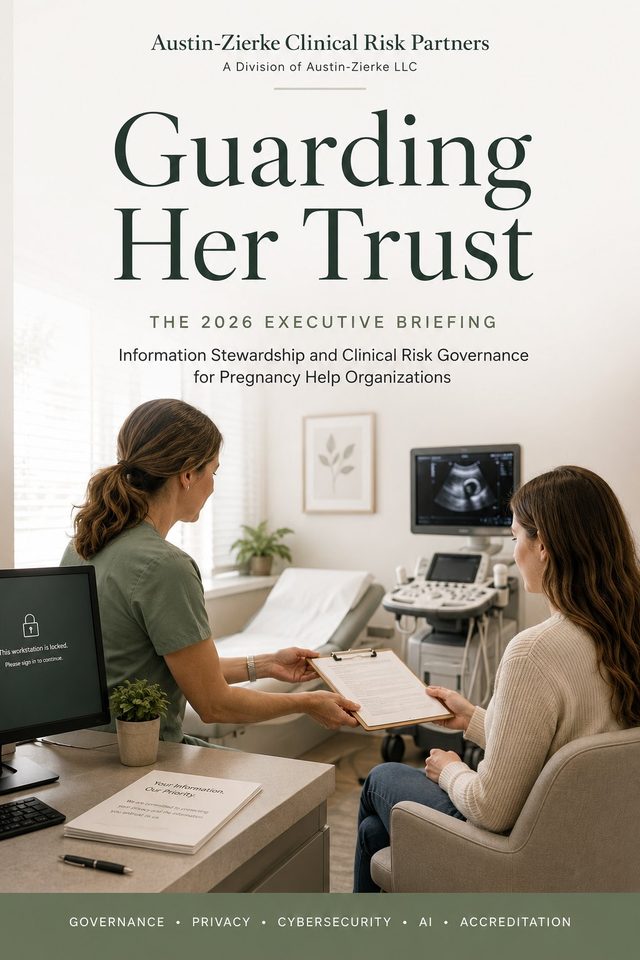
Guarding Her Trust: The 2026 Executive Briefing

For the boards, executive directors, and nurse managers of pregnancy help organizations.

What regulators are actually pursuing, the HIPAA question almost everyone gets wrong, what insurers and accreditors now expect, and a twelve-question self-assessment your board can complete in one meeting. Written in plain language, sourced from the public record, and free to share with your leadership in its complete form.

Get the free briefing

Delivered by email. Sent once, on request. Requesting the briefing does not add you to a mailing list — it subscribes you to nothing.

Who We Are

A partner engagement, not a software license.

Austin-Zierke Clinical Risk Partners, a division of Austin-Zierke LLC, provides cybersecurity, HIPAA, AI, and compliance oversight for healthcare nonprofits. We built Clinical Risk Monitor because the organizations that most need continuous risk management are the least able to staff it — and because the alternative on offer was software dashboards that generate findings no one reads and reports no one stands behind.

Our model is different by design. Industry-standard security tooling does the scanning. An AI analysis layer does the mapping and drafting — agentic AI focused on your mission. And a named, credentialed expert reviews the evidence, corrects the analysis, and signs the result. Every formal deliverable carries a human signature, because your board, your insurer, and your accreditor deserve a professional opinion, not a dashboard export.

We understand the organizations we serve: volunteer-heavy teams, donated equipment, budgets where every dollar competes with the mission. Our remediation plans are written to be achievable at that scale, and our engagement terms include a written commitment that you own every report, policy, and finding we produce — with full export and offboarding support if you ever leave.

Care without compromise. Compliance without chaos.

See where your organization stands.

A consultation is thirty minutes with a Clinical Risk Partners expert — not a sales presentation. We will discuss your systems, your regulatory posture, and your accreditation goals, and tell you plainly whether and how the program fits. If we are not the right fit, we will say so and point you somewhere useful.

Currently onboarding a limited number of organizations.

Questions, Answered Plainly

Frequently asked questions

Are you a certification body? Will this make us “HIPAA certified”?

No — and be cautious of anyone who says otherwise. There is no official government HIPAA certification; the Department of Health and Human Services does not certify or endorse any organization’s compliance, and neither do we. What we deliver is a verified privacy and security program aligned to HIPAA standards, documented by expert-reviewed reporting your board, insurer, and accreditor can examine. In this sector, inaccurate “HIPAA compliant” claims have themselves become the subject of state attorney general complaints — part of our work is making sure every public claim your organization makes is one it can prove.

We’re probably not a HIPAA covered entity. Why would we need this?

Many healthcare nonprofits are not covered entities — HIPAA generally applies to organizations that bill insurance electronically. But “not covered” is not the same as “not exposed.” State consumer-protection law governs every privacy promise on your website and intake forms; insurers condition coverage on documented safeguards; accreditors expect a working risk-management program; and attackers do not check your regulatory status. Our first deliverable in every engagement establishes, in writing, which rules actually apply to you — and aligns your practices and your public language to that answer. Read the full plain-language guide: Does HIPAA apply to your pregnancy help organization?

Is this software we have to run? Do we need technical staff?

No. Clinical Risk Monitor is a service delivered by experts — a partner engagement, not a platform license. We operate the tooling, perform the analysis, and deliver the results in plain language. You need no technical staff, and we coordinate with whoever currently supports your systems, whether that is an IT company or a capable volunteer.

What exactly does the AI do — and who is accountable for the results?

The AI accelerates the work; it never owns it. Our analysis layer normalizes scan findings, maps them to the safeguards and accreditation standards relevant to your organization, and drafts reporting. Then a named, credentialed compliance expert reviews the underlying evidence, corrects and edits the analysis, and signs the deliverable with their name, credentials, and date. Nothing is sent to a client unsigned, and the accountable party on every formal report is a human being at this firm.

Can an organization our size actually afford this?

Very likely, yes. Cost scales with your annual revenue, your workforce, and the number of locations you operate, rather than a one-size fee, so the smallest organizations are quoted at the smallest end of the range. We hold one pricing posture: the list price is the nonprofit price. Where budgets are genuinely tight, the consultation will tell you honestly which engagement level — or which smaller first step — fits, and some organizations qualify to treat this work as a funded program cost rather than administrative overhead. What we will not do is sell a stripped-down version that creates the appearance of a security program without the substance.

Why are you only onboarding a limited number of organizations?

Because every formal deliverable in this program is personally reviewed and signed by a credentialed expert, capacity is real and we manage it honestly. We are currently onboarding a limited partner cohort so that review quality — the entire point of the program — is never diluted by growth. Requesting a consultation places you in the queue with no obligation.

What happens to our reports and policies if we end the engagement?

They are yours. Every report, policy, finding, and piece of evidence we produce for your organization belongs to you, in full — that commitment is written into our engagement terms, along with export of your materials in standard formats and orderly offboarding support. A compliance program that holds your documentation hostage is not a compliance program.